●The Jomon Period: They were actually “gourmet settlers”
The Jomon people didn’t just roam the mountains and fields.
・The Legend of the Jomon Cookie: “Jomon cookies” have been excavated, made by grinding acorns and chestnuts into powder, mixing it with eggs and wild boar meat, and baking it. They’re surprisingly high in calories and packed with nutrition!
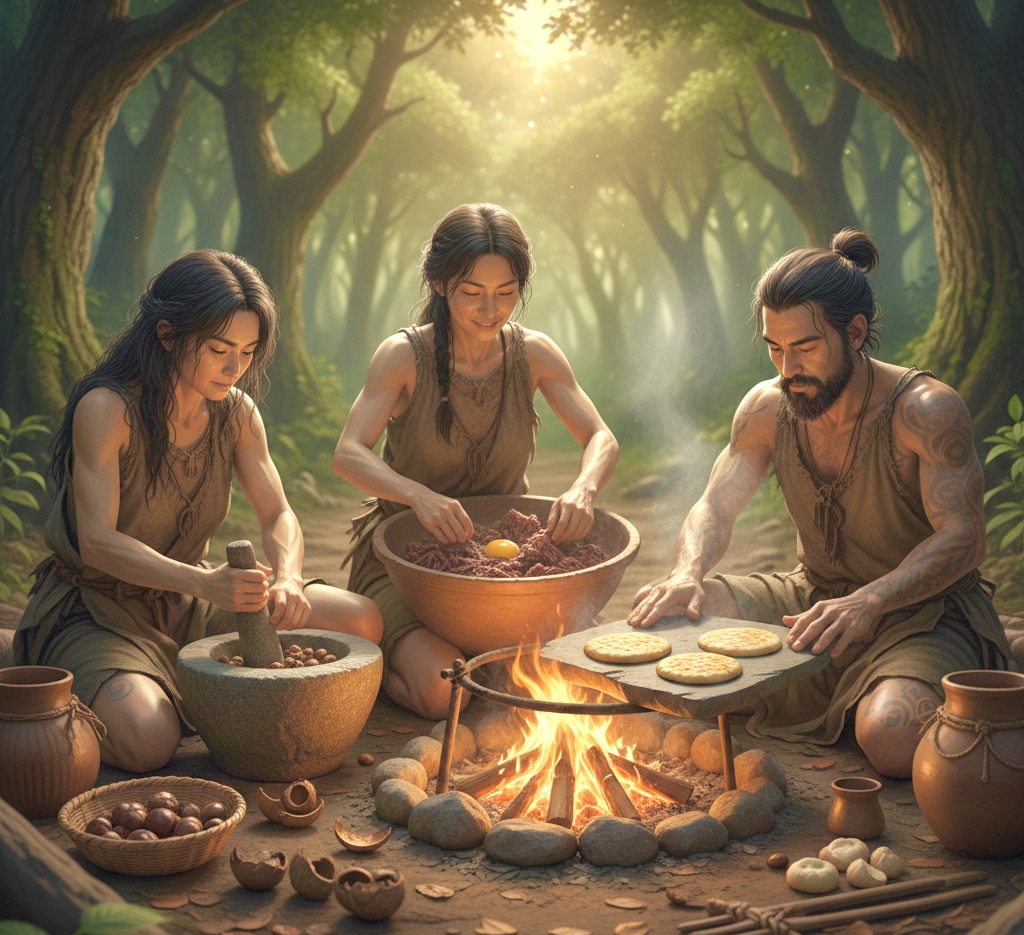
・Fascinating use of pouches: A woven pouch was discovered at the Sannai-Maruyama ruins in Aomori Prefecture. It is said to have contained walnuts, suggesting that they had the same idea of a “snack bag” as modern people.
●The Yayoi Period: Social Inequality and “Charms”
This was the era when rice cultivation began and the “haves” and “have-nots” began to emerge within villages.
・Is tooth extraction a trend?: As a coming-of-age ceremony, “tooth extraction” (basshi) was performed, in which healthy teeth were deliberately extracted. There is also a theory that the location of the extracted teeth represented “place of origin” or “married status,” and it seems to have been a poignant form of identification.
・Rice was “red”: At that time, common people ate mainly “red rice” (akagome), not the white rice of today. It was dry and was usually eaten steamed.
●Kofun Period: Fashion Starts at the Feet
While huge kofun tombs were being built, common people were also ingenious in unexpected places.
・Did they wear shoes?: There were sandals made of woven straw, but there were also ones that were similar to “jikatabi” socks. However, most common people basically worked barefoot, covered in mud.
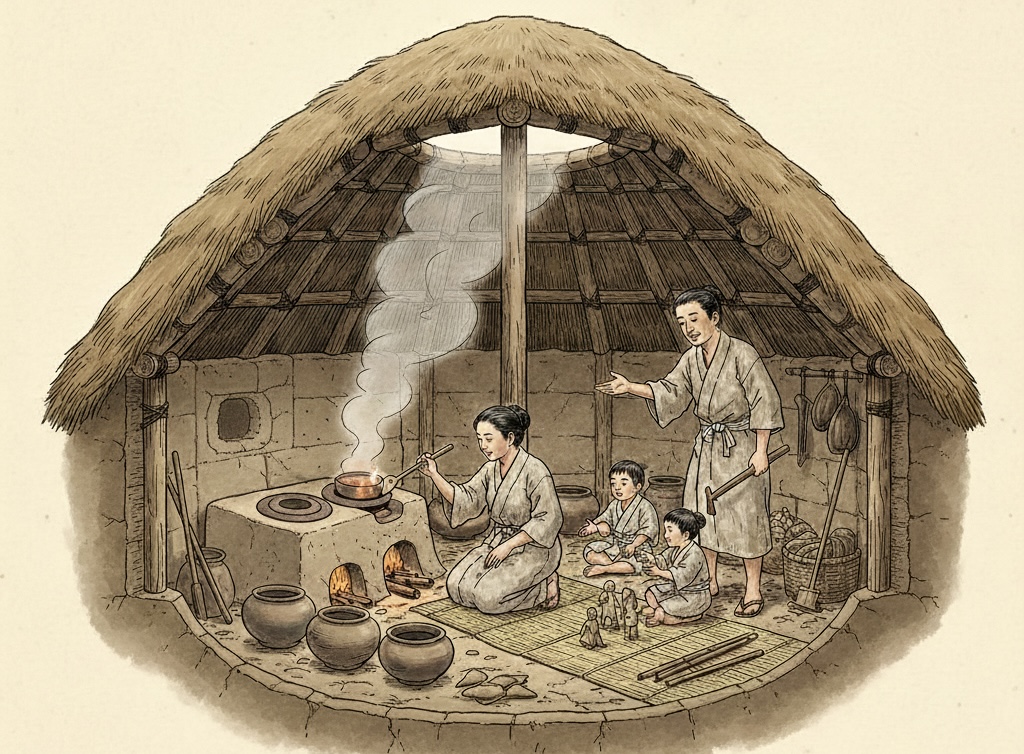
・The hearth revolution: During this period, the hearth was introduced from the Korean Peninsula. Until then, fires were lit in the center of the room, which caused a lot of smoke, but the construction of hearths against the wall dramatically cleaned the air in homes.
●Asuka Period: Surprisingly Hard Life with Taxes While the capital prospered, the burden on the common people reached its peak.
・Paying taxes on foot: Common people in rural areas had to transport “specialties” to the capital (such as Nara) on their own. This was called “unkyaku,” and they had to pay for their own food along the way. It was a life-risking tax payment, with some people even starving to death before reaching the capital.
・The truth behind the meat-eating ban: Emperor Tenmu issued a “meat-eating ban,” but this only applied to “cows, horses, dogs, monkeys, and chickens.” In fact, people secretly (or openly) ate wild boars and deer, calling them “mountain whales.”
●Nara Period: Not only did they not have surnames, but even their first names were random?
Commoners (farmers) at the time did not have surnames, but what’s even more surprising is how randomly they chose their names.
・Naming based on appearance or situation: There were many simple names such as “Hanamaro” because his nose was big, or “Maru” because his nose was round.
・Family registration is a battle against tax evasion: At the time, in order to avoid heavy taxes, false family registrations were common, in which men in their prime were falsely registered as women. There were even extreme cases where all the residents of a village were recorded as women.
The most difficult thing was offering one’s body (labor) as tax, so it is said that there were even “how-to’s on faking illness” to help people pretend to be sick.
●Heian Period: The staple foods of the common people were “black rice” and “strong rice.” While the nobility ate pure white rice, the diet of the common people was quite wild.
・Steamed rice (kowaii): Instead of cooking rice in a rice cooker like we do today, steamed rice was the norm. It was quite hard and chewy.
・Salt as a side dish: We couldn’t ask for luxuries, so the basics were rice, salt, and vinegar. Sometimes wild herbs or dried fish were added.
Furthermore, winter in the Heian period was a more life-threatening ordeal than we can imagine today, and behind the glamorous aristocratic culture, people endured the harsh cold and shortages of supplies.
・The architecture of the time (shinden-zukuri style) was designed for summer use, prioritizing ventilation, so it had zero insulation.
・Because crops do not grow in winter, people had no choice but to rely on preserved foods, which led to vitamin deficiencies and, as they were exposed to the cold in that state, many people lost their lives to epidemics.
Records of years when famine and epidemic occurred simultaneously (such as the “Yōwa Famine”) state that tens of thousands of bodies were found lying throughout the streets of Kyoto alone.
People who survived such winters took the following measures with the limited resources they had.
For the nobility: Physical isolation and layering
・Nurigome: The only small, sturdy room surrounded by walls in the shinden-zukuri style. Sleeping and waking in this room prevented drafts.
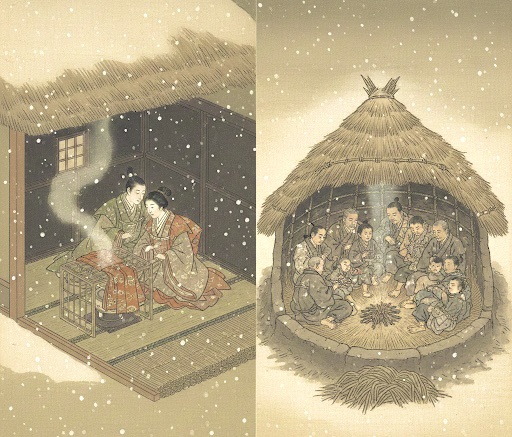
・Fusego and Hitori: A basket was placed over an incense burner, and kimonos were then draped over it to keep the clothes warm.
・Wata: Instead of modern-day cotton, silk wadding (stretched silk cocoons) was placed between clothes to provide insulation.
For the common people: crowding and ingenuity
・Continuation of pit dwellings: In contrast to the homes of the nobility, pit dwellings dug into the ground were surprisingly warm because they could utilize geothermal heat.
・Utilization of straw: People stuffed straw into their clothing or spread it thickly on the floor, serving a similar purpose to modern-day down jackets and insulation.
・”Sleeping together”: Families and relatives gathered in one place and shared each other’s body heat to keep warm and avoid freezing to death.
●Kamakura Period: The beginning of double cropping and an unprecedented tofu boom.
Agricultural techniques evolved during this period, and people’s lives began to change.
・The introduction of tofu: Tofu, which was introduced from China, gradually became more widespread around this time. At first it was eaten in temples as vegetarian food, but for common people it was considered a “magical nutritional food.”
・Baths were “steam baths”: At the time, sauna-like steam baths were the norm, rather than soaking in hot water. Common people often attended “alms baths” which temples opened to the public as a form of charity.
●Muromachi and Sengoku Periods: Surprisingly Highly Educated and Litigious
While these times have a rough and tumble image, they were also a time when the intellectual level of the common people soared.
・Village autonomy (Souson): Villagers decided on rules through discussion and negotiated with their lord on an equal footing. If the lord made unreasonable demands, they were strong enough to go on strike, known as “chosan,” in which the entire village boycotted work.
・Ability to read: Something like the prototype of a terakoya school appeared, and an increasing number of peasants were able to remember their own names and do simple arithmetic. They were smart enough to see through the bluffs of Sengoku daimyo.
●Azuchi-Momoyama period and late Edo period: Full of energy, filled with a sense of playfulness and rationality that is still relevant today.
① The “flashy” boom of the Azuchi-Momoyama period
The era of Nobunaga and Hideyoshi (the Azuchi-Momoyama period) was dominated by the kabuki culture, where anything “flashy and new” was considered cool.
・Were Sengoku warlords sweets-loving men?: In an era when sugar was an ultra-luxury commodity, Nobunaga favored Nanban sweets (such as konpeito), and treating them to guests was considered the ultimate status symbol.
・Baths were “steam baths”: At the time, people didn’t just soak in hot water, but sauna-like “steam baths” were the norm. During the Azuchi-Momoyama period, the prototypes of public baths began to appear, and they became popular social gathering places.
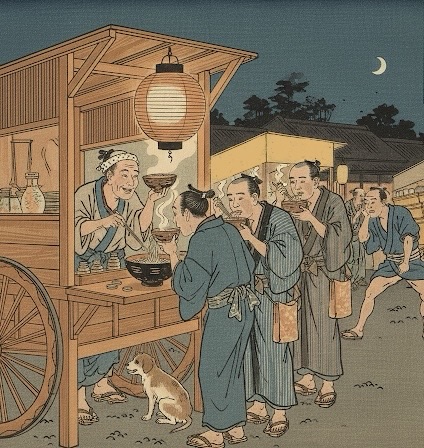
② Edo-period Fast Food: Common people in the Edo period were extremely impatient, and the culture of eating out was highly developed. The origins of modern fast food can all be found in this period.
・Nigirizushi was twice the size of today: It was like the rice balls you quickly eat at food stalls, and each piece was two to three times the size of today (the size of a rice ball).
・Tempura was skewered: A stylish way to eat freshly fried tempura skewered on a skewer was to eat it standing up like a snack.
・Origin of the “nihachi” (28/8) soba noodle ratio: One theory is that 2 x 8 = 16, so a bowl was 16 mon, and another theory is that it refers to a ratio of 2 parts wheat flour to 8 parts buckwheat flour, but for common people at the time, it was synonymous with “cheap and quick.”
③Circular Recycling
Edo was a unique “circular recycling” society, producing no waste.
・The occupation of “ash buyers”: Even the ashes left in hearths were purchased. Ash was reused as fertilizer, detergent, and dye・”Buying old umbrellas” and “buying old nails”: Specialized companies would buy and thoroughly recycle everything from broken umbrella ribs to single nails found in burnt remains.
・The ultimate in “night soil”: Human waste was sold to farmers as an excellent fertilizer. It’s surprising to hear that in urban tenement buildings, this was a valuable source of additional income for landlords.
④Travel was a booming leisure activity. Although the shogunate restricted travel, common people were still able to travel for pilgrimages such as to Ise Shrine.
・A dog visiting the shrine alone? “Okage Inu”: A truly peaceful sight was seen when a dog with a bag around its neck with the words “Ise Pilgrimage” written on it and some travel money went to visit the shrine in place of its owner who was ill and unable to go, with the help of some travelers.

・Travel guidebooks: Humorous books like “Tokaido Chu Hizakurige” became bestsellers, and with “Meishozue,” a modern-day travel magazine, in hand, ordinary people enjoyed traveling by walking 30 to 40 km a day.
●Common to all eras
・The ultimate recycling society: Paper was remade over and over again (kanshi), clothes were patched together until they were tattered (sashiko), and then turned into rags, and finally, they were burned as fertilizer. The lives of ordinary people were surprisingly sustainable, even today.
The “toughness” of the common people at that time is somehow inspiring.
コメントを残す