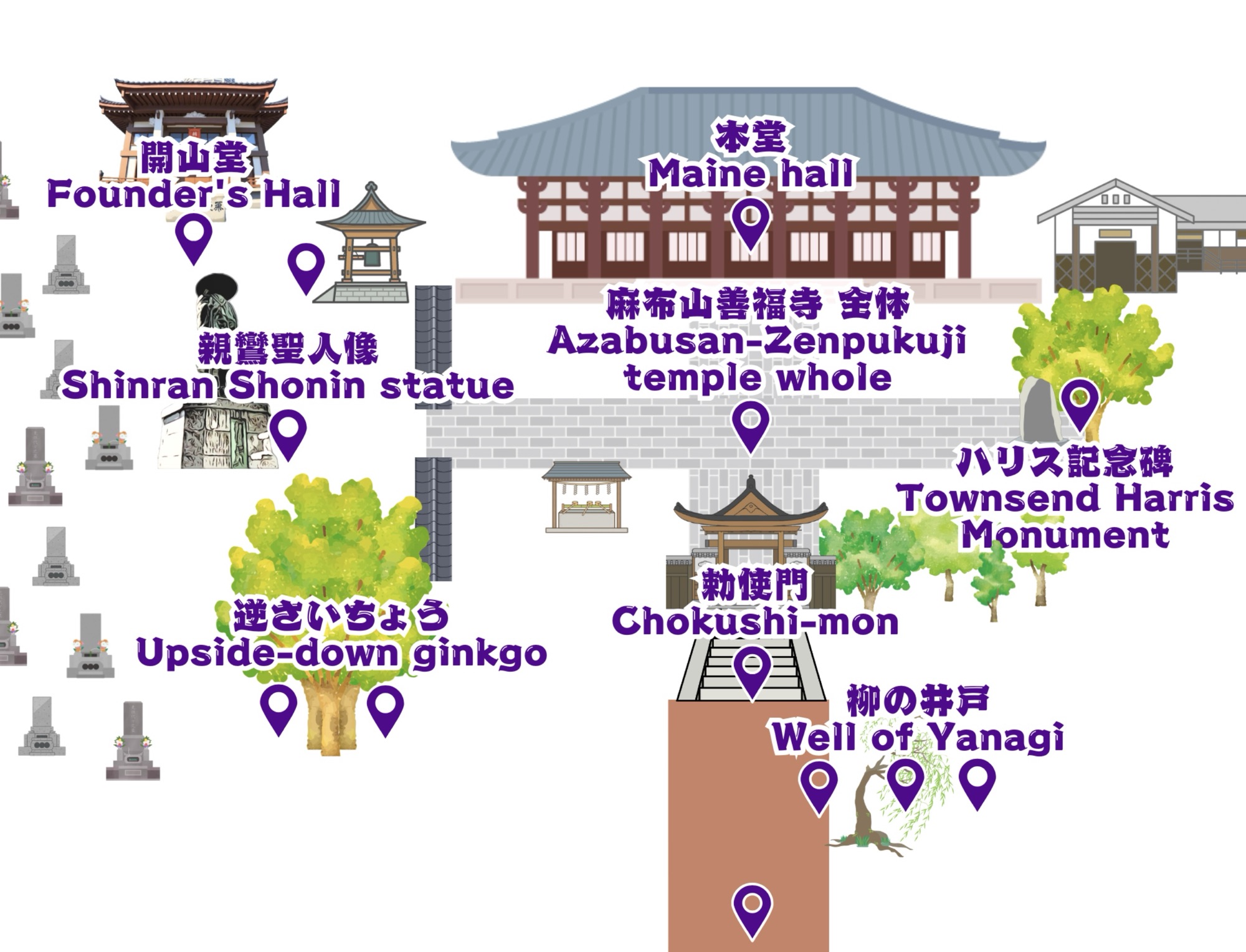
The map icon is a VR 360-degree image!
●For PC users
Touch the icon for the location you want to view →
It’s like you’ve been warped there! You can view in 360°♪
+For VR headset users
Touch the square icon in the upper right →
Enjoy in VR mode!
● For smartphone users
Touch the icon of the location you want to display →
A message will appear on the screen saying “This immersive website requires access to your device’s motion sensors.” Select “Allow” →
A message will appear saying “We’re requesting access to your motion and orientation.” Select “Allow” →
It’ll be like you’ve been transported there! Enjoy a 360° view!
地図のアイコンは、VR360度画像になっています!
●パソコンの方
表示したい場所のアイコンをタッチ→
そこにワープしたかの様に!360°ご覧になれます♪
+VRヘッドセットの方
右上の四角いアイコンをタッチ→
VRモードでお楽しみいただけます!
●スマートフォンの方
表示したい場所のアイコンをタッチ→
This immersive website requires access to your device motion sensors.(この没入型ウェブサイトは、デバイスのモーションセンサーへのアクセスが必要です)と画面に出るので、Allow(許可)を選択→
“動作と方向“へのアクセスを求めています を、許可を選択→
そこにワープしたかの様に!360°ご覧になれます♪
Azabusan-Zenpukuji temple
(Heian period)
In 794, at the end of the 8th century, the capital of Japan was moved to Heian-kyo in Kyoto, and the period of about 400 years from then on was called the Heian period.
Japan began sending envoys to China in the early 7th century (Ken Sui Shi and Ken Tang Shi), and continued until 838 in the 9th century. Many students accompanied the envoys and learned about the systems and culture of the continent. Among the students were Buddhist monks, one of whom was a monk named Kukai.
The Buddhist scriptures that were officially introduced to Japan in the 6th century were mainly translated into Chinese and written in kanji that Japanese people could read, but Kukai studied Sanskrit in depth, and after returning to Japan, he founded a Buddhist sect called Shingon, which involves chanting Sanskrit spells to gain worldly benefits through supernatural powers.
Azabusan Zenpukuji is said to be the temple that Kukai (Kobo Daishi) founded to spread Shingon Buddhism throughout the Kanto region.
(Kamakura period)
The next period in Japan following the Heian period is the Kamakura period, which lasted from the end of the 12th century to the first half of the 14th century.
The Kamakura shogunate, located in what is now Kamakura, Kanagawa Prefecture, held power during this period, but it was also during this time that new ideas were born in the field of Buddhism in Japan.
One of these teachings, “Senshu Nembutsu,” which holds that universal salvation can be achieved by chanting the Nembutsu with single-minded heart, captured the hearts of many people.
However, these teachings, which were very different from traditional Buddhism, were seen as heretical in the Buddhist world, and Shinran, the founder of the Jodo Shinshu sect, was exiled to Niigata.
It is said that after Shinran was pardoned from exile, he visited this place on his way back to Kyoto, and Ryokai, a priest at Zenpukuji Temple, was so impressed by Shinran’s virtue that he converted from Shingon Buddhism to Jodo Shinshu.
麻布山善福寺
(平安時代)
8世紀末の794年、日本の首都は京都の平安京に移され、そこから約400年間は、「平安時代」と呼ばれました。
7世紀初頭に始まった我が国から中国への使者の派遣(遣隋使・遣唐使)は、9世紀838年まで続き、多くの留学生が同行し、大陸の制度や文化を学びました。留学生の中には僧侶もいて、その一人が、空海という僧でした。
6世紀に我が国に公伝した仏教の経典は主に中国語に訳され、日本人にも読める漢字で書かれたものでしたが、空海はサンスクリットを深く学び、帰国後、サンスクリットの呪文を唱えて神通力による現世利益を得る「真言宗」という仏教の宗派を開きます。
空海(弘法大師)が真言宗を関東一円に広めるために開いた寺院と伝わるのがこのお寺、麻布山善福寺です。
(鎌倉時代)
平安時代に続く日本の時代区分が鎌倉時代で、12世紀末から14世紀前半まで続きます。
現在の神奈川県鎌倉に置かれた鎌倉幕府が権力を持ちましたが、この時代にも、我が国では仏教の分野で新しい考えが生まれました。
その中の一つ、一心に念仏を称えればあまねく救われるとする「専修念仏」の教えが人々の心をつかみます。
しかしながら、従来の仏教とは大きく異なるその教えは仏教の世界では異端視され、浄土真宗の開祖である親鸞も新潟に流罪となります。
親鸞が流罪を赦免された後、京都に帰る途中にこの地を訪れ、親鸞の高徳に傾倒した善福寺の了海上人が真言宗から浄土真宗に改宗したと伝わります。
コメントを残す