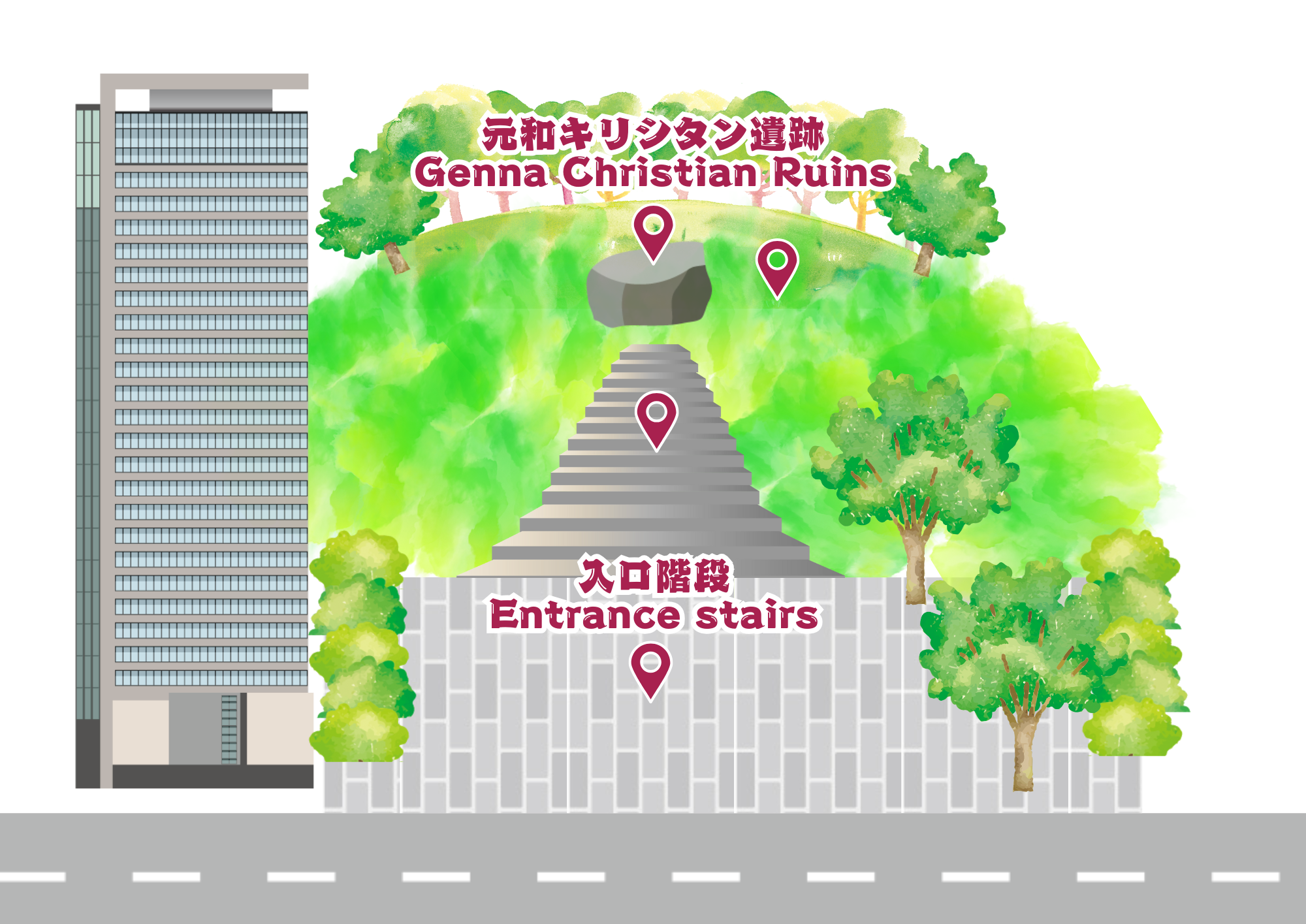
The map icon is a VR 360-degree image!
●For PC users
Touch the icon for the location you want to view →
It’s like you’ve been warped there! You can view in 360°♪
+For VR headset users
Touch the square icon in the upper right →
Enjoy in VR mode!
● For smartphone users
Touch the icon of the location you want to display →
A message will appear on the screen saying “This immersive website requires access to your device’s motion sensors.” Select “Allow” →
A message will appear saying “We’re requesting access to your motion and orientation.” Select “Allow” →
It’ll be like you’ve been transported there! Enjoy a 360° view!
地図のアイコンは、VR360度画像になっています!
●パソコンの方
表示したい場所のアイコンをタッチ→
そこにワープしたかの様に!360°ご覧になれます♪
+VRヘッドセットの方
右上の四角いアイコンをタッチ→VRモードでお楽しみいただけます!
●スマートフォンの方
表示したい場所のアイコンをタッチ→
This immersive website requires access to your device motion sensors.(この没入型ウェブサイトは、デバイスのモーションセンサーへのアクセスが必要です)と画面に出るので、Allow(許可)を選択→
“動作と方向“へのアクセスを求めています を、許可を選択→
そこにワープしたかの様に!360°ご覧になれます♪

↑The QR code above features an AR pop-up effect!
①Turn on your smartphone camera and point it at the QR code above (enable location access in Settings beforehand).
②Select Allow, OK, and Close.
③Something will appear in the space♪Check it out in 360°!
↑上記のQRコードは、ARが飛び出る仕掛けになっています♪
①スマートフォンのカメラを起動、上記QRコードにかざす(事前に設定で位置情報をONにする)
②許可、OK、閉じる を選択
③空間に何かが出ます♪360°見てね!
Genna Christian Ruins(Near Tamachi Station. Site of the martyrdom of Christians executed by Tokugawa Iemitsu in 1623)
From the mid-15th century to the early 17th century, Japan was in a period of constant warfare between warlords fighting for supremacy across the country.
The person who put an end to these wars was a military commander named Tokugawa Ieyasu. He was appointed Shogun by the Emperor in 1603 and founded the Edo Shogunate (Tokugawa Bakufu), a government based in Edo (present-day Tokyo) that lasted until the mid-19th century.
The Tokugawa Shogunate, which was established after many years of civil war, placed importance on domestic stability, and initially tried to limit the negative impact of Christianity, a foreign religion, on domestic politics by restricting its propagation.
However, in 1620, a ship heading from Manila to Japan was seized by the British and Dutch near Taiwan, revealing an attempted smuggling of Spanish missionaries. This led to the “Hirayama Jyouchin Incident,” which increased the shogunate’s vigilance towards Christianity.
Eventually, the shogunate began mass arrests of Christians, and many of them were executed.
The Genna Christian Ruins is the site of the martyrdom of 50 Christians who were executed in 1623 under these circumstances.
Later, in Japan, in 1637-1638, the Shimabara Rebellion, a large-scale armed conflict by Christians in the Shimabara and Amakusa regions of Kyushu, occurred.
After the rebellion was suppressed, the ban on Christianity was strengthened, and Japan then moved down the path of “national isolation,” which prohibited all contact with the outside world in principle.
元和キリシタン遺跡(田町駅近く。元和9年(1623年)徳川家光に処刑されたキリスト教信者の殉教遺跡)
15世紀半ば〜17世紀初頭まで、我が国では、各地に群雄割拠する武将が戦いを繰り返す時代が続きました。
この戦乱を終わらせたのが徳川家康という武将で、1603年に天皇から征夷大将軍を任ぜられ、江戸(現在の東京)を中心に、19世紀半ばまで続く政権・江戸幕府(徳川幕府)を築きます。
長年の内戦状態の末に成立した徳川幕府は国内の安定を重視、海外の宗教であるキリスト教については当初布教を規制することにより、国内政局への悪影響を抑えようとしていた模様です。
ところが元和6年(1620年)マニラから日本へ向かう船がイギリス・オランダにより台湾近海で拿捕され、スペイン人宣教師の密入国未遂が明らかになる「平山常陳事件」が発生した事で、幕府のキリスト教への警戒感が高まります。
やがて幕府は、キリスト教徒の大量捕縛に踏み切り、多数のキリスト教徒が処刑されました。
この「元和キリシタン遺跡」は、このような状況の中で、元和9年(1623年)に処刑されたキリスト教信者50名の殉教遺跡となっています。
なお、その後、我が国では、寛永15〜16年(1637〜1638年)に九州の島原・天草地方でのキリスト教徒による大規模な武力闘争事件「島原の乱」が発生。
乱鎮圧後、キリスト教禁止が強化され、その後、海外との交流を原則禁止する「鎖国」への道を進んで行くことになります。
コメントを残す